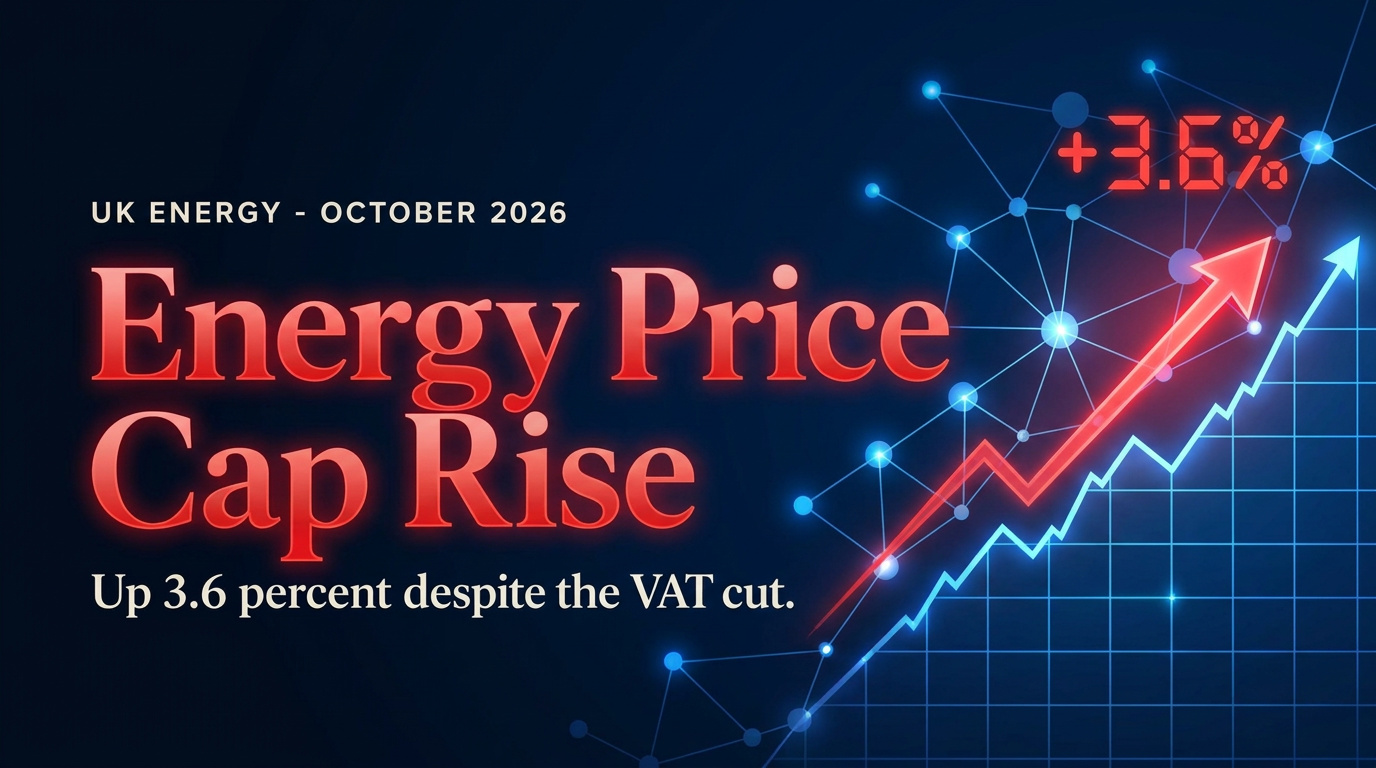
Why is there another energy price cap rise despite the VAT cut? Ofgem confirms a 3.6% increase — to £1,723 a year — from 1 October 2026, because the tax cut only softens the underlying rise in costs.
Key Takeaways
- Ofgem's October 2026 price cap rises 3.6% to £1,723/year for a typical dual-fuel household on direct debit, up from £1,663 — confirmed 26 August 2026.
- Without the government's electricity VAT cut, the rise would have been closer to 6% — Martin Lewis puts the VAT cut's effect at roughly 2.5 percentage points, not the whole increase.
- The VAT cut takes electricity VAT from 5% to 0% for six months, 1 October 2026 to 31 March 2027, saving the average household about £25 over that period, according to the Institute for Fiscal Studies (IFS).
- Rising wholesale gas prices — the gas unit rate is up 8.7% — are the dominant driver this quarter; electricity costs stayed comparatively flat because of the VAT removal.
- IFS director Helen Miller has criticised the VAT cut as poorly targeted, since higher-income households use more electricity and capture a disproportionate share of the £850m saving.
- Ofgem is already forecasting a further 8.7% rise to roughly £1,872/year for the January 2027 cap.
- The price cap limits unit rates and standing charges on default tariffs — it is not a cap on your total bill.
- Greentech Renewables has completed 2,000+ solar, battery, heat pump and EV charging installations over 15+ years, rated 4.9★ from over 120 customer reviews.
What is the Ofgem energy price cap and why is it changing in October 2026?
The energy price cap is the maximum Ofgem allows suppliers to charge per unit of gas and electricity, and per day in standing charges, on default (variable) tariffs. It's reviewed every three months — in January, April, July and October — to track the wholesale cost of buying energy on international markets, along with network, policy and operating costs. It does not cap your total bill: use more energy and you pay more, even within the cap.
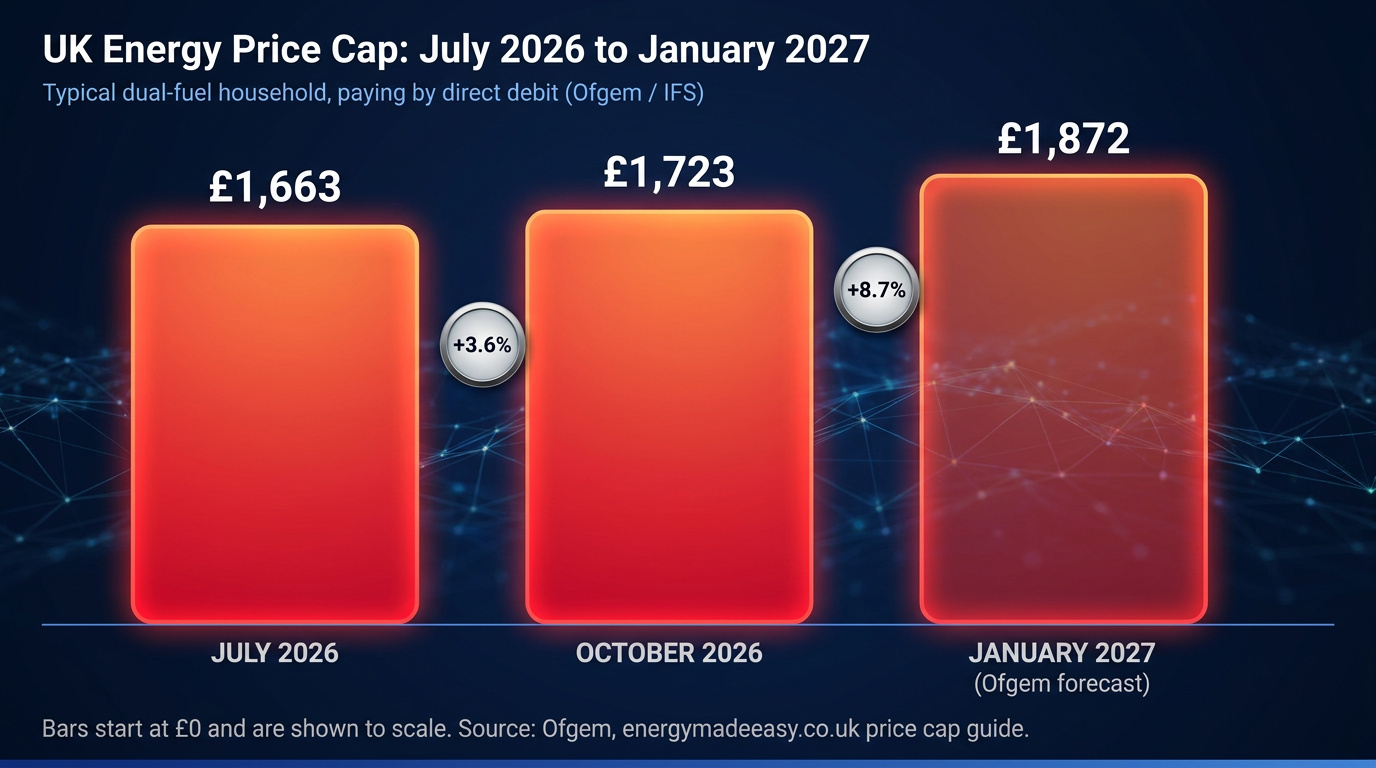
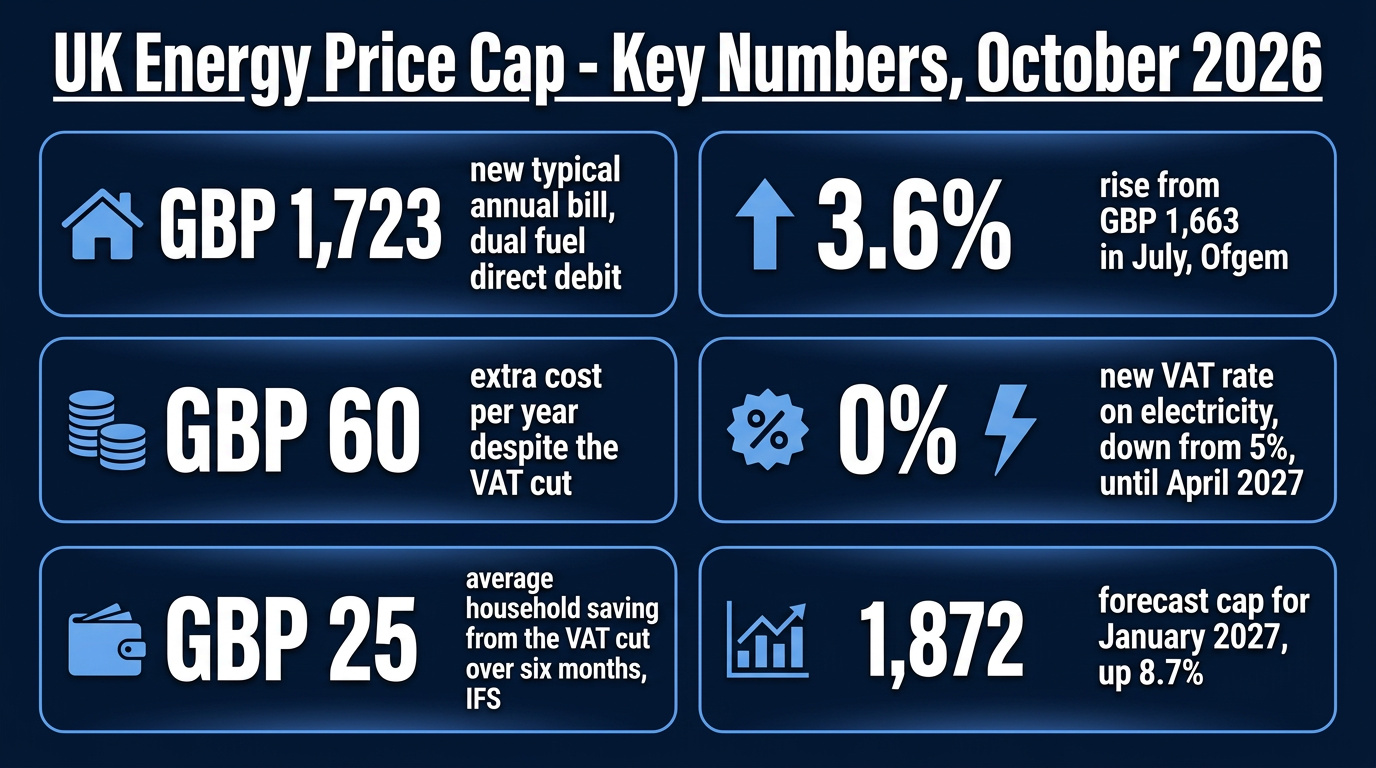
For October 2026, Ofgem has confirmed a typical dual-fuel household paying by direct debit will see its annual bill rise to £1,723, up 3.6% from £1,663 in July. That's an extra £60 a year, or roughly £5 a month, according to Ofgem's 26 August 2026 announcement. For a full walkthrough of how the mechanism works, see our earlier guide to what the new energy price cap means every October.
Why is the energy price cap rise happening despite the VAT cut?
Because the VAT cut only cancels out part of the increase — it was never designed to eliminate it. The government cut VAT on domestic electricity from 5% to 0% for six months from 1 October 2026, specifically to soften this quarter's rise. But the underlying cost pressure, mostly from gas, was bigger than the tax cut could absorb.
As Martin Lewis explained on MoneySavingExpert: "Without that, we would have seen a 2% extra rise. So the price would have probably been going up around 6% rather than 3.6%." In other words, the VAT cut is worth roughly 2.5 percentage points off the cap — not a bill freeze, a partial offset.
How much will the October 2026 energy price cap rise cost UK households?
In cash terms, the October 2026 rise adds £60 a year to a typical dual-fuel bill on direct debit — £1,723 versus £1,663 in July. The table below shows how the typical bill has moved over the last two reviews, plus Ofgem's early forecast for January 2027.
| Price cap period | Typical annual bill | Change | Main driver |
|---|---|---|---|
| July 2026 | £1,663 | — | Consumption basis revised (usage assumptions lowered) |
| October 2026 (confirmed) | £1,723 | +3.6% | Gas wholesale prices up 8.7%, partly offset by 0% electricity VAT |
| January 2027 (Ofgem forecast) | ≈£1,872 | +8.7% (forecast) | Continued gas market pressure; forecast, not confirmed |
What's driving the rise — wholesale costs, network charges, or something else?
Gas is doing almost all of the damage this quarter. Ofgem's October figures show the gas unit rate rising 8.7% (to 7.97p/kWh) and the gas standing charge up 2.2%, driven by volatile international gas markets and the ongoing Middle East conflict. Electricity, by contrast, moved by less than 1% on the unit rate and actually fell on the standing charge — because it's the one part of the bill the VAT cut directly touches.
What does the electricity VAT cut actually do?
From 1 October 2026 to 31 March 2027, VAT on domestic electricity drops from 5% to 0%. VAT on domestic gas is unaffected and stays at 5% — an inconsistency the Institute for Fiscal Studies (IFS) has flagged as adding complexity to the tax system. The government's own announcement frames it as "breathing space" on the cost of living, funded by cancelling the digital ID programme — an £850m cost to the Treasury for 2026–27.
In practice, the IFS estimates the average household saves around £25 over the full six months — a real but modest saving next to a £60 annual rise.
Is the VAT cut poorly targeted? What the IFS found
The IFS's Helen Miller argues it is. Because it's a proportional cut, households that use more electricity save more in pounds — and higher-income households tend to use more electricity overall. The IFS notes that "a disproportionate share of the cost of today's tax cut will go to higher-income households who use more electricity overall," even though lower-income households spend a much larger share of their budget on energy (around 5% of spending for the lowest-income tenth, versus 2% for the highest).
The IFS also points out that electricity prices have risen only about 5% since the Middle East conflict began pushing gas prices up, compared with a 24% rise in gas — which makes electricity VAT an odd lever to pull for cost-of-living relief, since gas is where most of the pain is.
What happens after October — is another price cap rise coming?
Probably, yes. Ofgem's early forecast puts the January 2027 cap at roughly £1,872/year, an 8.7% rise on top of October's figure — though this is a forecast, not a confirmed number, and it will move as wholesale gas prices move between now and Ofgem's next announcement. If gas prices ease over autumn, the forecast could come down; if the situation driving prices stays volatile, it could go the other way.
Martin Lewis has also warned that "fix rates today are the most expensive they've been for three years," so locking into a fixed tariff isn't automatically the answer either — it depends on whether the fixed rate beats where the cap is heading.
How to protect your energy bills before the next price cap rise
None of these fully insulate you from a rising cap, but each reduces your exposure:
Check fixed tariffs against the cap. Compare what's on offer with where the cap actually sits — not where it might go — before switching.
Submit a meter reading around 30 September. This stops your supplier estimating usage across the rate change and charging some of it at the wrong rate.
Check Warm Home Discount and grant eligibility. Support like the £150 Warm Home Discount, and separate schemes covering insulation and heating upgrades, are worth checking even if you've dismissed them before — our guide to income-based solar grants covers who currently qualifies.
Reduce the electricity you're buying at the capped rate in the first place. This is where solar panels and battery storage fit in — not as a way to dodge the price cap story entirely, but as a way to buy less of your electricity at whatever the cap happens to be each quarter. A typical home still draws some grid electricity even with solar installed, particularly overnight, so it works alongside these other steps rather than replacing them. If you're weighing it up, our solar savings calculator and battery storage savings guide use your actual usage rather than the "up to 70%" headline figure, and our page on what solar panels cost in the UK in 2026 covers current pricing and 0% finance options.
If you already have solar, check whether you're getting a competitive rate for electricity you export back to the grid — the Smart Export Guarantee rates vary a lot between suppliers, and switching who buys your exported electricity is often overlooked. There are also tax reliefs worth knowing about, covered in our note on renewable energy tax benefits in the UK.
Why homeowners are choosing solar with Greentech Renewables now
None of the above is an argument that solar erases the price cap story — it doesn't. But the trend in this article is the honest case for looking at it now rather than waiting: the cap has risen in back-to-back reviews, the VAT cut is temporary and worth a modest £25 over six months, and Ofgem's own early forecast already points to another 8.7% rise in January 2027. Generating even part of your own electricity is one of the few things in this picture you can actually control, rather than a cap review you have no say in.
If you're weighing that decision, it's worth knowing who you'd be trusting with it. Greentech Renewables is an MCS-certified, TrustMark-approved installer with 15+ years and 2,000+ completed installations, and the pattern across our reviews is consistent rather than cherry-picked:
Reviewers consistently describe the installation itself as professional, clean and stress-free from start to finish, crediting polite and helpful on-site staff.
A recurring theme is how clearly the team explains each step — comprehensive, detailed information that's easy to follow rather than technical jargon.
Customers frequently note the pricing was reasonable and transparent, with no unexpected extra costs or hidden fees once the work began.
Reviewers also point to after-sales support and general operational efficiency as consistently exceeding what they expected going in.
None of that replaces doing your own sums — the solar savings calculator and 0% finance options are there so you can see real numbers for your own roof before you decide anything.
Frequently Asked Questions
What is the UK energy price cap in October 2026?
Ofgem's October 2026 price cap sets a typical annual bill of £1,723 for a dual-fuel household paying by direct debit — up 3.6% (£60) from £1,663 in July 2026. The cap runs from 1 October to 31 December 2026 and limits the unit rates and standing charges suppliers can charge on default (variable) tariffs, not your total bill.
Why is the price cap rising if the government cut VAT on electricity?
Because the VAT cut only offsets part of the increase. Rising wholesale gas prices — driven largely by the ongoing Middle East conflict — pushed gas unit rates up 8.7%, which is the dominant cost in this review. Martin Lewis has estimated that without the VAT cut, the rise would have been closer to 6% instead of 3.6%, meaning the tax cut saved roughly 2.5 percentage points, not the whole increase.
How much will the electricity VAT cut actually save me?
The Institute for Fiscal Studies estimates the average household saves around £25 over the six-month period the cut is in place (1 October 2026 to 31 March 2027). Because it's a proportional tax cut, households that use more electricity save more in cash terms — which is part of the IFS's targeting criticism below.
Is the VAT cut on electricity permanent?
No. It's a temporary, six-month measure from 1 October 2026 to 31 March 2027, cutting VAT on domestic electricity from 5% to 0%. VAT on domestic gas is unaffected and stays at 5%. The IFS has noted that making the cut permanent would require further, unspecified spending cuts beyond the digital ID programme cancellation that funds the current six months.
Will the energy price cap rise again in January 2027?
Ofgem's early forecast points to a further 8.7% increase, taking the typical bill to roughly £1,872/year — though forecasts this far out change as wholesale markets move, and the confirmed figure won't land until Ofgem's next quarterly announcement.
Does the price cap limit my total energy bill?
No — a common misconception. The price cap limits the unit rate (pence per kWh) and standing charge (pence per day) on default tariffs, not the total amount you pay. If you use more energy, you pay more, even under the cap. It also doesn't apply if you're on a fixed tariff, which may sit above or below the cap level.
How can I protect myself from future price cap rises?
Compare fixed tariffs against the current cap level, submit meter readings around 30 September to avoid estimated billing across the rate change, check eligibility for the Warm Home Discount, and look at reducing underlying usage — insulation, a more efficient heating system, or generating some of your own electricity.
Does solar power reduce my exposure to the price cap?
It reduces exposure to the unit-rate portion of your bill, because self-generated electricity used at home isn't bought at the capped rate at all. It doesn't remove standing charges or the need for grid electricity on low-generation days, so it works best alongside — not instead of — the other steps above. Our guide on whether solar panels are worth it breaks down the real payback numbers.
Ready to see what solar would actually save on your bill?
No cold calls, no 24-hour deadlines — just a straight answer, in writing, on whether solar and battery storage make sense for your home. Try the free solar savings calculator or read what Martin Lewis has said about solar panels before you decide.
